Most dentists and office managers don’t struggle to understand hiring advice; they struggle to apply it consistently.
If you read through the hiring rules discussed in the previous article, none of them should have felt surprising.
They reflect what most practices experience firsthand: hiring when the schedule is full, scanning resumes, reacting strongly to early red flags, using working interviews to confirm fit, and watching how a new hire performs once they’re actually in the office.
So why does following that advice feel harder now than it did a few years ago?
It’s because the hiring environment has changed.
Let’s find out how . . .
How the Dental Hiring Environment Has Changed
Dental hiring no longer starts when a resume lands in your inbox.
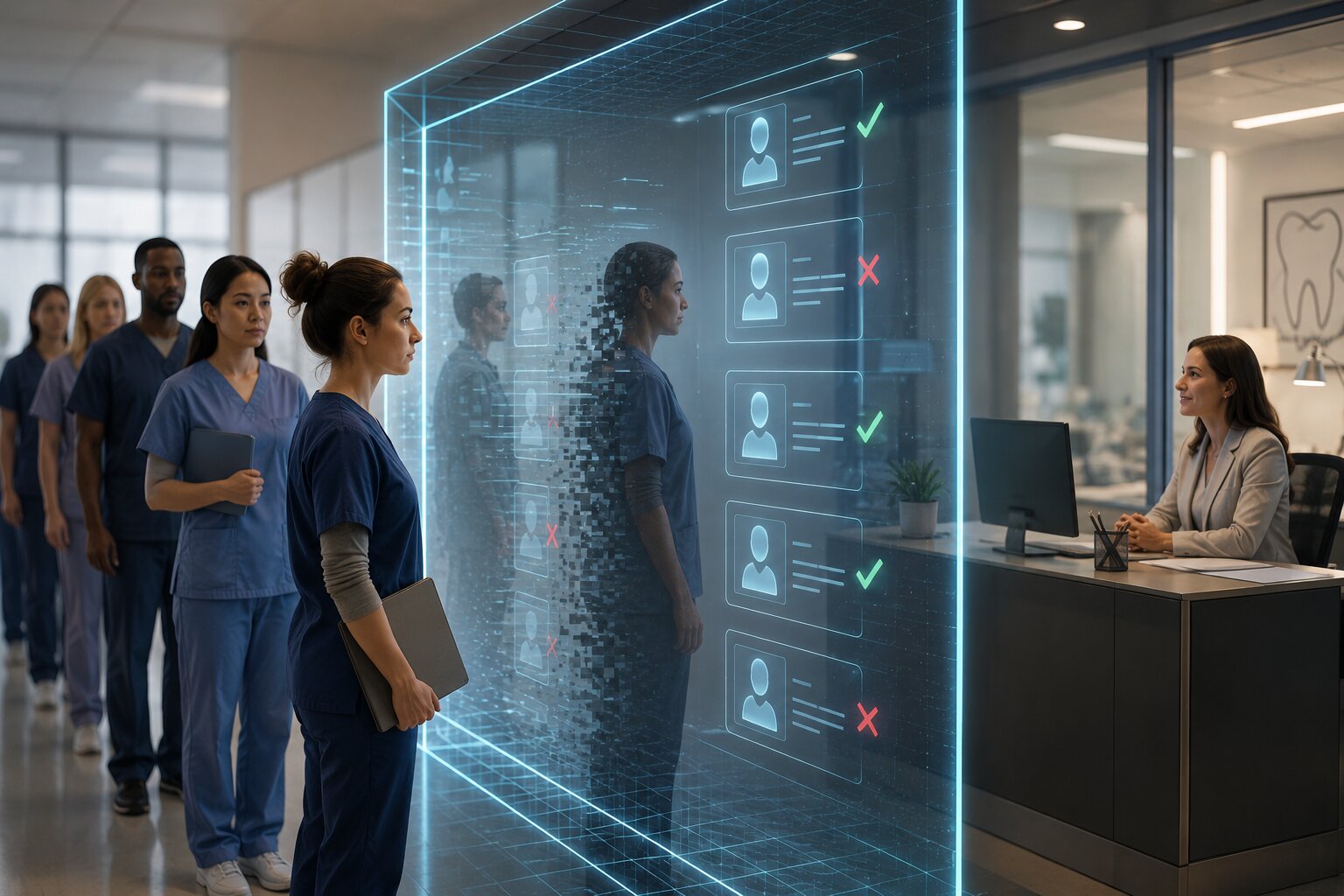
Today, hiring often begins inside software systems that sort, filter, and prioritize candidates before anyone in the office reviews an application from:
- Availability settings
- Automated screening rules
- Keyword matching
This isn’t unique to dentistry.
Research across industries shows that automated systems and AI now influence and impact hiring. both those who enter the hiring funnel as potential future hires, and the outcomes they shape before human review occurs.
For dental offices, this means fewer resumes reach the decision-maker. Instead of reviewing every applicant, practices often review a short list generated by system rules.
This doesn’t remove judgment from the process, but it does change where judgment happens in the screening process.
AI, Automation, and the Modern Hiring Process
Think back to the last time you went through the hiring process.
You reviewed a short list of candidates that the system surfaced. On paper, they all looked fine. Credentials checked out. Availability matched what you needed. Nothing obvious stood out—good or bad.
But when one of them came in, something felt off.
On paper, everything still checked out. But once they were in the office, you started to notice things that no resume or system could flag:
- The answers were technically correct, but the conversation felt strained
- They struggled to adjust when the schedule shifted or the pace changed
- Patients didn’t seem fully at ease
- The team didn’t quite click or flow naturally around them
None of this showed up on the resume—and none of it was something the system could screen for.
That’s the practical reality of modern hiring.
The tools did exactly what they were designed to do. They narrowed the list, sorted by availability, and moved applications quickly so the office wasn’t buried in resumes.
But they didn’t answer the questions that actually matter once someone is in the chair, at the front desk, or moving through the operatory.
AI hasn’t changed how dentists or office managers decide who will work well in their practice.
It changes when those decisions are made.
If this feels familiar, it’s not just a gut feeling.
Organizations that study how AI is used in hiring have been pointing out the same pattern. Automated tools are helpful at the front end of the process—sorting applications, filtering based on set criteria, and reducing volume. Where they fall short is in the areas dental practices care most about: communication, adaptability, judgment under pressure, and how someone functions as part of a real team.
The U.S. Department of Labor has even issued guidance around AI-powered hiring tools, noting that while they can improve efficiency, they also shape who gets seen and when—often before a human decision-maker is involved. That’s why employers are encouraged to understand the limits of these systems rather than rely on them to evaluate fit.
In practical terms, that means many of the signals dentists and office managers rely on don’t appear early in the process. They show up later—during interviews, while someone is actually working, and often in the first few weeks on the job.
That’s why hiring can feel less intuitive than it used to. Not because instincts have changed, but because they’re being applied later than they once were.
Why Hiring Advice Gets Shortened (and Why That Matters)
When resumes start coming in, the goal usually isn’t to make a final decision. It’s to narrow the field quickly enough to keep the day moving. Most offices end up doing some version of the same thing: sorting candidates into a mental yes pile—people who look workable on paper and are worth bringing in for a closer look.
That early sorting is useful.
Why?
It helps manage a large number of potential resumes that are just sitting on a desk or in an email inbox and keeps the hiring process from stalling. But it also means decisions are being made with limited information. Good candidates can be passed over early, while others move forward simply because nothing obvious disqualified them yet.
That’s why structured frameworks and hiring rules tend to stick. Under pressure, they’re easier to apply quickly and consistently.
But structure alone doesn’t replace judgment. It just buys time until judgment can be applied — later, when someone is interviewed, observed, and actually working in the office.
What Hasn’t Changed About Hiring
Despite changes in technology and process, the core principles of hiring remain the same.
Research on AI in recruitment shows that while automation reshapes workflow, decisions based on day-to-day performance, team dynamics, and patient interaction continue to drive long-term success.
If a hiring framework reflects how decisions are actually made in a dental office, it tends to remain useful—even as tools and platforms evolve.
What This Means for Dental Offices Right Now
Dental offices don’t need entirely new hiring rules.
They need room to apply the ones they already rely on.
In a hiring environment where screening happens early and judgment happens later, flexibility matters. Working interviews, temporary placements, and even permanent hires work best when practices can gather real-world information. How someone communicates, adapts to the pace of the day, and fits with the existing team.
Here’s where Princess Dental Staffing tends to come into the picture for a lot of offices.
Sometimes it’s as simple as needing coverage now and seeing how someone works while they’re there. Other times, it’s a way to get a better sense of a candidate before deciding whether to move forward with a permanent hire. There isn’t one “right” path — the value is having options once you’ve seen how things actually play out in the office.
None of this removes risk completely. But it shifts decisions away from guesswork and propel hiring toward real-world experience. This makes long-term choices easier to stand behind when making hiring decisions for your office.
Where This Leads
Hiring feels harder than it used to for a simple reason: judgment is delayed.
The rules dentists and hiring managers rely on haven’t disappeared. What’s changed is when they get to apply them.
Early stages of hiring now focus on narrowing who gets seen. The real evaluation still happens later—when someone is interacting with patients, adapting to the schedule, and working alongside the team.
The question isn’t, “What rule did I miss?”
It’s, “Does this process give me enough real-world information to decide?”
This mirrors how decisions are actually made in a dental office: through observation, interaction, and experience.
Related Articles
Ready to get started?
Join Princess Dental Staffing for free!